The PHAZE System: Your Clear Path to Airbrushing Mastery
How bite-sized skill progression eliminates overwhelm and keeps you practicing
After 40 years of airbrushing—30 years as a professional artist, 16 years specializing in Hollywood FX makeup and airbrush tattoos, and 10 years training employees to run my FX tattoo shop for high-level events and corporate experiential activations—I’ve watched countless talented people pick up an airbrush with excitement, only to put it down in frustration weeks later. The problem isn’t a lack of talent or dedication. The problem is how airbrushing is typically taught.
Most tutorials throw you into the deep end: “Here’s how to paint a realistic portrait” or “Let’s create a complex mural.” Meanwhile, you’re still figuring out how to get consistent paint flow without splattering everywhere. It’s like trying to run before you can walk—overwhelming, discouraging, and completely unnecessary. Also, not every type of airbrushing is alike.
People trying to learn airbrush tattoos typically don’t learn to airbrush first; instead, they rush into the tattoo application stage without safe application basics or a concept for the tattoo art part! This leads people to frustration and eventually to quitting before they get ahead.
That’s why I developed the PHAZE System: A proven progression framework that breaks airbrushing mastery into manageable, stackable skills. No overwhelm. No guesswork. Just clear steps that build confidence as you go.
The Problem with Traditional Airbrushing Education
Here’s what typically happens when someone decides to learn airbrushing:
They buy an airbrush kit, watch a few YouTube tutorials, and attempt to recreate what they see. The tutorial makes it look easy—smooth gradients, crisp lines, perfect control. But when they try it themselves, the paint splatters. The lines wobble. The gradient looks muddy. Within a few sessions, frustration sets in. The airbrush goes back in the box, and another aspiring artist gives up. OR WORSE, they put out the shingle as an “airbrush artist” and begin taking people’s money, EVEN THOUGH they are barely figuring it out. This reflects on all airbrush artists.
Why does this happen? I only know because I’ve been closely observing this for years.
Traditional airbrushing instruction focuses on technical step-by-step instructions instead of progression and stacking of skills. You’re shown the finished result without understanding the foundational skills that make it possible. It’s like watching a chef prepare a five-course meal and expecting to replicate it without ever learning knife skills, heat control, or flavor balance.
The result? Overwhelm, poor results, and abandonment.
Based on industry data and my own observations training employees and students over the past decade, nearly 70% of people who start learning airbrushing on their own quit within the first month. Not because they lack ability, but because they lack a clear path forward.
Enter the PHAZE System: Skill Stacking for Sustainable Progress
The PHAZE System solves this problem by breaking airbrushing mastery into three distinct phases, each building directly on the skills you mastered in the previous phase. Think of it like learning a language: you start with the alphabet, then words, then sentences, then conversations. Each level prepares you for the next.
Here’s how it works:
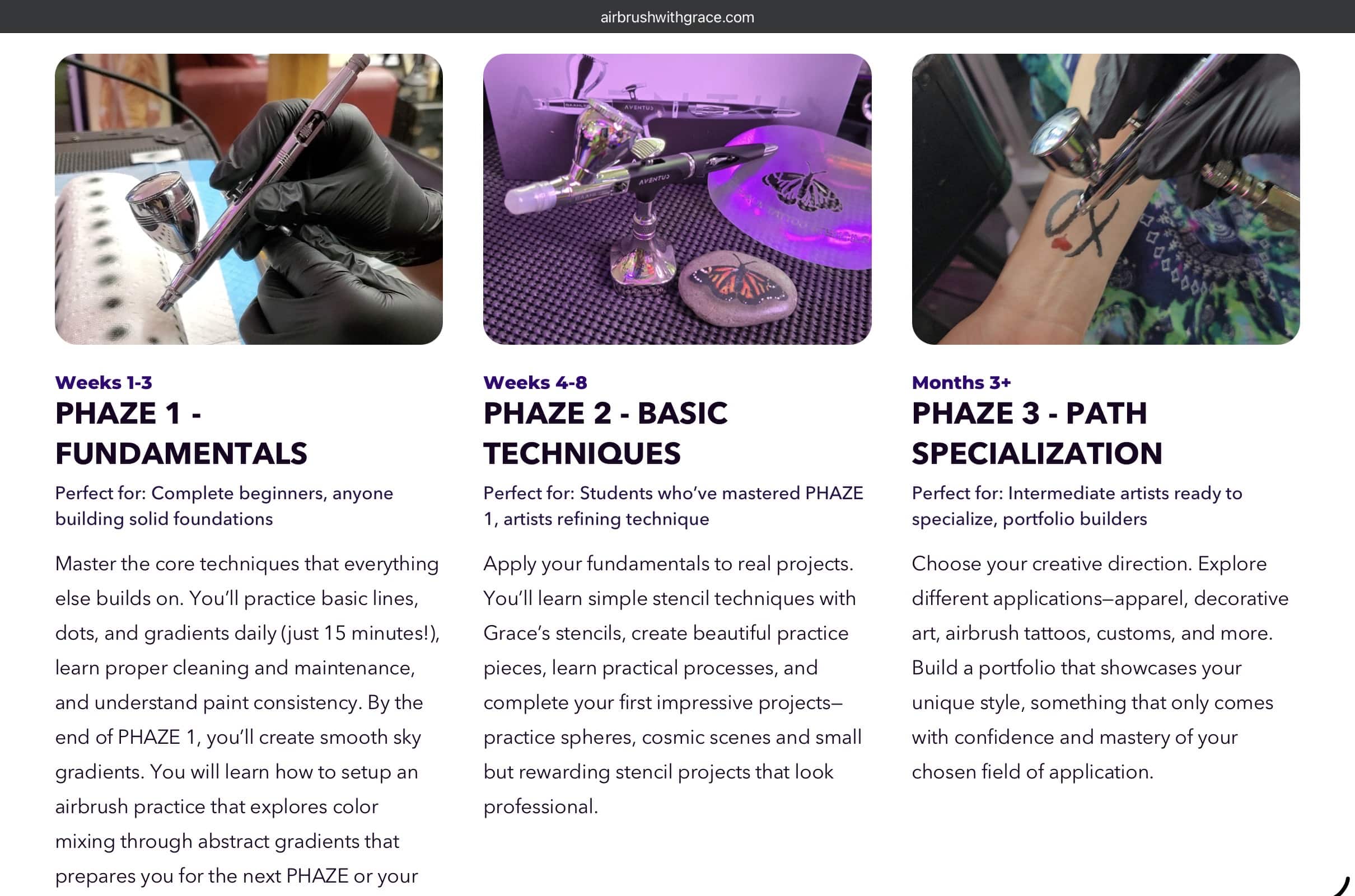
PHAZE 1: Fundamentals (Weeks 1-3) What you learn: The core mechanics that everything else builds on.
In PHAZE 1, you’re not creating finished projects. You’re building muscle memory and control. This phase focuses on three essential skills:
Basic lines, dots & comets- You’ll practice drawing straight lines, curved lines, consistent dots, and comets. This teaches you trigger control (how much paint comes out), distance control (how far the airbrush is from the surface), and flow (how your body moves with your strokes). These are the building blocks of every airbrushing technique.
Smooth gradients- You’ll learn to create even color transitions—light to dark, one color to another. This teaches you paint consistency, hand movement speed, and overlapping passes. Gradients are the foundation of airbrushing in general, giving you the control needed for realistic shading and dimensional work.
Proper maintenance- You’ll learn to clean your airbrush correctly, troubleshoot common issues (splattering, inconsistent spray), and understand paint-to-thinner ratios. A well-maintained airbrush is a controllable airbrush. My airbrushes are always pristine – because my business relies on them!
Why this matters: These aren’t “beginner exercises”—they’re the exact techniques I use as a professional airbrush artist every single day. The difference between a beginner and a pro isn’t the complexity of what they create; it’s the precision and consistency of their foundational skills.
Time commitment: Just 15 minutes of daily practice to start. That’s it. Consistency beats marathon sessions every time. I guarantee you will want to practice more – because you will see results fast.
What you’ll achieve by the end: You’ll create smooth sky gradients that look professional. You’ll feel confident handling your airbrush. And most importantly, you’ll understand why your airbrush behaves the way it does, which means you can troubleshoot problems instead of getting frustrated.
PHAZE 2: Basic Techniques (Weeks 4-8)
What you learn: How to apply your fundamentals to real projects.
Now that you have control, it’s time to create. PHAZE 2 introduces stencils, layering, and project completion—the skills that turn practice exercises into impressive finished work.
Simple stencil techniques- You’ll learn to use stencils (including my Grace X Stencils line at The Stencil Foundry) to create clean shapes, crisp edges, and repeatable designs. Stencils are the secret weapon of professional airbrush artists like me – they save time, ensure consistency, and allow you to create complex designs without freehand drawing skills.
Two-color blends and layering- You’ll combine your gradient skills with stencil work to create depth and dimension. This is where your work starts to look “professional”—shadows, highlights, and color transitions that make flat surfaces look three-dimensional. Airbrush mastery is found in the skies. Every gradient skill can be mastered by painting the atmosphere and sky.
Even coverage over larger areas- You’ll learn to paint T-shirts, canvas, and other surfaces with smooth, consistent color. This teaches you paint flow management, overlapping technique, and how to avoid streaks or blotches, no matter what you decide to paint.
Your first impressive projects- You’ll complete practice spheres (which teach shading, form, and color theory) and cosmic scenes (which teach color blending and atmospheric effects). These projects look stunning—good enough to gift or sell—but they’re built entirely from the fundamentals you mastered in PHAZE 1.
Why this matters- PHAZE 2 is where students experience the “aha!” moment. Suddenly, the lines and gradients you practiced make sense. You’re not just doing exercises—you’re creating art. This is the phase where confidence skyrockets and people start calling themselves “airbrush artists.”
Time commitment- 2-3 practice sessions per week, 30-60 minutes each. You’re building projects now, so sessions are longer, but you’re also seeing tangible results.
What you’ll achieve by the end: A portfolio of finished projects you’re proud to show off. The ability to create professional-looking work on multiple surfaces. And the confidence to experiment with your own ideas.
PHAZE 3: Path Specialization (Months 3+)
What you learn: How to develop your unique style and choose your creative direction.
By PHAZE 3, you have the fundamentals and the project experience. Now it’s time to specialize. This is where you choose your path based on your interests, goals, and creative vision. Or choose them all, as long as you understand each type of airbrushing requires different supplies, different airbrushes, and different techniques. We suggest conquering one technique at a time.
Precision detail work. You’ll develop the control needed for fine lines, intricate patterns, and realistic rendering. Whether you’re painting portraits, custom vehicles, or detailed illustrations, this phase teaches you to work at any scale.
Application specialization. You’ll explore different mediums and choose your focus:
• Airbrush tattoos: Temporary body art for events, parties, and entertainment venues
• Apparel: Custom T-shirts, hoodies, and wearable art
• Decorative art: Canvas paintings, home décor, and gallery-worthy pieces
• Customs: Helmets, motorcycles, guitars, and personalized items
• Fine art: Illustration, portraiture, and professional artwork
We will offer professional Workshops for Airbrush Tattoos, Airbrush Streetwear and Apparel Applications, and Airbrushing for Fine Art Applications in our Creator Portal.(By invitation only)
Portfolio building. You’ll create a cohesive body of work that showcases your style and attracts clients or opportunities. This is where you transition from “learning airbrushing” to “being an airbrush artist.”
Why this matters: PHAZE 3 is where you stop following tutorials and start creating from your own vision with or without our stencils. You have the skills. You have the confidence. Now you have the creative freedom to make airbrushing whatever you want it to be—a side income, a full-time career, or a deeply satisfying creative outlet.
Time commitment: Ongoing practice and project work. At this stage, you’re self-directed—you know what you want to create and how to get there.
What you’ll achieve: A professional portfolio, a defined artistic style, and the skills to pursue airbrushing at whatever level you choose.
Why Skill Stacking Works: The Science Behind PHAZE
The PHAZE System isn’t just a teaching preference—it’s based on how our brains actually learn motor skills.
Chunking reduces cognitive load- When you try to learn too many things at once, your brain gets overwhelmed. By breaking airbrushing into discrete skills (dots> comets> lines> gradients> stencils), you can focus on mastering one thing at a time. Once a skill becomes automatic, it frees up mental space to learn the next skill.
Stacking builds confidence- Every skill you master becomes the foundation for the next. When you start PHAZE 2, you’re not learning from scratch—you’re building on skills you already have. This creates a sense of progress and momentum that keeps you motivated.
Repetition creates muscle memory- The 15-minute daily practice in PHAZE 1 isn’t arbitrary. Research shows that short, frequent practice sessions are more effective for motor skill development than longer, less frequent sessions. By the time you finish PHAZE 1, your hands know what to do without conscious thought. You know how to clean your airbrush and set it up for the next session. You are building a “practice”.
Visible progress prevents abandonment. The biggest reason people quit learning new skills is a lack of visible progress. The PHAZE System ensures you see improvement every single week. Week 1, your lines are shaky. Week 2, they’re straighter. Week 3, they’re consistent. By Week 4, you’re creating gradients that look professional. That visible progress keeps you engaged. And the timing all depends on you. Practice more, progress faster. Practice less, progress slower. Go at your own pace.
PHAZES vs. PORTALS: Pathways and Practice Environments
Here’s where students sometimes get confused: PHAZES and PORTALS are not the same thing.
PHAZES are the recommended pathway. Think of PHAZES as your roadmap- They tell you what to learn and in what order. PHAZE 1 → PHAZE 2 → PHAZE 3 is the proven progression that takes you from beginner to confident artist.
PORTALS are the practice environments- Portals are where you access the content and do the work. Each Portal contains lessons, tutorials, projects, and community support. You move through the PHAZES by working within the Portals.
Here’s how they work together:
AWG Entry Portal (FREE)
What’s inside: The complete Airbrush 101 Mini Course, covering PHAZE 1.
Who it’s for: Complete beginners, anyone building foundational skills.
What you’ll learn: All of PHAZE 1 (tools, supplies, fundamentals & basic techniques). By the time you complete the Entry Portal, you’ll have finished projects and the confidence to call yourself a budding airbrush artist.
Why it’s free: I believe everyone should have access to quality airbrushing education. The Entry Portal removes the financial barrier and lets you experience the PHAZE System before committing to paid memberships.
AWG Explorer Portal (PAID MEMBERSHIP $49mo)
What’s inside: PHAZE 2 and early PHAZE 3 content. Intermediate & Advanced techniques and advanced stencil work.
Who it’s for: Students who’ve completed the Entry Portal and want to expand their skills.
What you’ll learn: Advanced stencil techniques, multi-layer projects, surface-specific applications, and the beginning of specialization (choosing your creative direction).
Why it’s paid: This level includes personalized feedback, advanced tutorials, and ongoing support as you develop your unique style.
AWG Airbrush Tattoo Portal (PAID MEMBERSHIP $79mo)
What’s inside: Everything you need to specialize in airbrush tattoos—from body art techniques to event setup to building a tattoo business.
Who it’s for: Artists who want to focus on temporary body art
What you’ll learn: Skin-safe products, tattoo application, client interaction, event logistics, and how to turn airbrush tattoos into a profitable side income or full-time business.
AWG Creator Portal (PAID MEMBERSHIP $99mo)
What’s inside: Business development, marketing, product creation, and turning your airbrushing skills into income. (Events, parties, entertainment venues).
Who it’s for: Artists ready to monetize their skills—whether through selling finished work, teaching, or building an airbrushing business.
What you’ll learn: Pricing strategies, client acquisition, social media marketing, product photography, Etsy/online sales, and how to build a sustainable creative business.
How to Navigate PHAZES and PORTALS Start with the Entry Portal. Work through PHAZE 1 and PHAZE 2. Practice daily. Complete the projects. Build your confidence.
Choose your next Portal based on your goals:
• Want to keep expanding your general skills? → Explorer Portal
• Ready for advanced techniques? → Airbrush 201 Portal
• Want to specialize in tattoos? → Airbrush Tattoo Portal
• Ready to turn this into income? → Creator Portal
You can be in multiple Portals at once- Students can be in the Explorer Portal (expanding skills) AND the Creator Portal (building a business) simultaneously. The Portals support each other—you’re learning new techniques while also learning how to market and sell your work. (We will open the Creator Portal SOON)
The PHAZES guide you, but you control the pace. Some students move through PHAZE 1 in three weeks. Others take six weeks. That’s fine. The PHAZE System is a roadmap, not a race. Progress at your own pace, and trust that each skill you master prepares you for the next.
Real Results: Why the PHAZE System Works
Over the past decade of training employees and developing this system for high-level professional work, I’ve tracked completion rates and student progress. Here’s what the data shows:
Entry Portal completion rate: 78%. Compare that to the industry average of 30% for online courses. Why the difference? The PHAZE System keeps students engaged with visible progress and manageable steps.
Average time to first sale: 3-4 months. Students who complete PHAZE 2 and join the Creator Portal make their first sale (Etsy, local events, commissions) within four months on average. That’s because they have both the skills AND the business knowledge to turn their work into income.
Student satisfaction: 94%. When surveyed, 94% of students say the PHAZE System made learning airbrushing “easier and less overwhelming” compared to other methods they tried.
But the numbers don’t tell the whole story. Here’s what students say:
“I tried learning airbrushing three times before finding AWG. Every time, I got frustrated and quit. The PHAZE System finally made it click. I’m not overwhelmed anymore—I know exactly what to practice and why.” — Sarah M., Entry Portal graduate
“The daily 15-minute practice in PHAZE 1 seemed too simple to work. But after three weeks, I looked back at my first attempts and couldn’t believe the difference. I actually have control now!” — Mike T., Explorer Portal member
“I went from ‘I can’t even draw a straight line’ to selling unique airbrushed T-shirts on Etsy in six months. The PHAZE System gave me the confidence to call myself an artist.” — Jessica L., Creator Portal member
The Bottom Line: Progress Over Perfection
Here’s what I want you to understand: You don’t need to be naturally talented to become a skilled airbrush artist. You need a clear path, consistent practice, and the right progression of skills. The rest will come in a surprisingly short period of invested time.
The PHAZE System gives you all three.
PHAZE 1 teaches you control. PHAZE 2 teaches you the application and techniques. PHAZE 3 teaches you specialization.
Each phase builds on the last. Each skill stacks on the previous one. And every step forward is visible, measurable progress.
No overwhelm. No guessing. Just clear, proven steps that work.
Whether you want to create art for yourself, sell your work, or build a full-time airbrushing business, the PHAZE System gets you there—one manageable skill at a time.
Ready to Start Your Journey?
The AWG Entry Portal is completely free and includes the full Airbrush 101 Mini Course (PHAZE 1 and PHAZE 2). You’ll get:
• Grace’s tools and supplies list – Everything you need to get started
• Step-by-step video tutorials for every technique
• Downloadable practice guides and project templates
• Access to the AWG community of fellow learners
• Progress tracking to see your improvement over time
No credit card required. No trial period. Just free, quality beginning airbrushing education to get you started right.
Join the AWG Entry Portal (FREE) →
Frequently Asked Questions
Q: How long does it take to complete each PHAZE?
A: PHAZE 1 typically takes 3 weeks with 15 minutes of daily practice. PHAZE 2 takes 4-8 weeks with 2-3 practice sessions per week. PHAZE 3 is ongoing—it’s where you continue developing your skills and style indefinitely.
Q: What if I’ve already been airbrushing for a while? Should I still start with PHAZE 1?
A: If you’re struggling with consistency or control, yes—PHAZE 1 will fill in foundational gaps. If you’re already comfortable with basics, you can start with the Explorer Portal and PHAZE 2 or apply for an invite to jump into a specialized Portal (Tattoo, 201, etc.). The Entry Portal is free, so you can assess your skill level and start where it makes sense. We recommend everyone start at PHAZE 1.
Q: Do I need expensive equipment to start?
A: No. You can start with a basic dual-action airbrush and compressor, which I recommend from Gaahleri (around $100-150 total). Don’t forget my Gaahleri Airbrush link is a 20% discount! I provide equipment recommendations in the Entry Portal, and I prioritize quality over price—you don’t need expensive gear to learn solid technique.
Q: Can I really learn airbrushing in 15 minutes a day?
A: PHAZE 1 requires just 15 minutes of daily practice because you’re building muscle memory, which happens through repetition, not marathon sessions. PHAZE 2 requires longer sessions (30-60 minutes) because you’re completing projects, but you only need 2-3 sessions per week. Quality practice beats quantity every time.
Q: What if I get stuck or frustrated?
A: That’s what the AWG community is for. Every Portal passed the Explorer Portal includes access to our community forum, where you can ask questions, share your work, and get feedback. Plus, the PHAZE System is designed to prevent frustration—if you’re stuck, it usually means you’re trying to skip ahead. Go back one step, master that skill, then move forward.
Q: How is this different from YouTube tutorials?
A: YouTube tutorials show you what to create with limited guidance. The PHAZE System teaches you how to develop the skills to create anything. It’s the difference between following a recipe and learning to cook. One gives you a single result; the other gives you the ability to create on your own.
Ready to experience the difference? Join the AWG Entry Portal and start PHAZE 1 today.
Grace has been airbrushing for over 40 years, including 30 years as a professional artist and 16 years specializing in Hollywood FX makeup and airbrush tattoos. For the past decade, she’s trained her artists to execute high-level events and corporate experiential activations. The PHAZE System is the culmination of this professional experience—the exact progression she uses to train artists who work on 500+ person events.